Investments

Mutual Fund

A mutual fund is a professionally managed type of collective investment scheme that pools the Mutual Fund Investors monies together and typically invests in securities, stocks and bonds (short-term and long-term bonds). A Mutual Fund Manager that is responsible for a particular fund or family of funds may invest in money market instruments, other mutual funds in a fund of funds, other securities and or commodities or a wider range of Mutual Fund Categories. The fund manager trades, buys and sells all types of investments in different mutual fund sectors, geographical sectors and diversifying funds amongst emerging and established markets along with many other investing options and instruments available that are set out in the mutual fund prospectus the one important document that clearly explains the type of fund, style of the manager and the overall stated objectives of the investment fund.
Registered Retirement Savings Plan (RRSP)

A registered retirement savings plan (RRSP) is a flexible, attractive savings tool. In addition to reducing your tax bill, it enables you to accumulate significant amounts and to defer income tax on your investment returns. The sooner you start saving, the more quickly your savings will start working for you.

Who Should Consider an RRSP?

  • Any person under the age of 71 who has employment income.
  • Features and Advantages of Our Plan
  • You deduct the amounts contributed from your taxable income.
  • You obtain an income tax deferral on your investment income.
  • Your protection against financial market fluctuations may attain and
  • even exceed 100% of the capital         invested.
  • You can borrow to increase your contributions through the RRSP loan
  • to invest through the IAG Savings and Retirement Plan.
  • You can pay by pre-authorized cheques.
  • You pay no annual administration fees.
  • Amounts withdrawn are taxed according to the tax tables in effect.

Under the regulations, an RRSP must be converted to a registered retirement income fund (RRIF), or another retirement income instrument by December 31 of the year you turn 71.
Tax-Free Savings Account (TFSA)

The Tax-Free Savings Account (TFSA) is the most exciting innovation in personal savings since the creation of the Registered Retirement Savings Plan (RRSP) by the government of Canada.

The TFSA is a unique tax-free savings program (non-RRSP) now offered by Industrial Alliance to help you:

  • Accumulate   more savings to pursue personal projects, TAX FREE
  • Place   income generated by invested sums (existing investments,investment income,   inheritances, donations, etc.) in a tax shelter account
  • Maximize   your savings with retirement in mind

Advantages of the TFSA

If you’re a Canadian resident age 18 or older, you can benefit from a savings account that offers the following advantages:

Simple   and accessible

You can contribute up to $5,000 annually in a tax-free account, regardless of   your income.

Tax   free

Any earnings generated (interest, capital gains or dividends) in the TFSA, as   well as sums withdrawn, are not taxable.

Cumulative  contribution room

Unused annual contribution room accumulates indefinitely.

Ease   of withdrawals

You can withdraw any amount at any time without penalty. *There is no   restriction as to the use of withdrawals.

Ideal  complement to an RRSP

The TFSA investment instrument complements an RRSP as an efficient way to   save and put more money toward your retirement.

No   affect on income-based government benefits

Neither TFSA contributions nor its earnings affect eligibility for the   Guaranteed Income Supplement, Old Age Security, the Canada Child Tax Benefit   or other government benefits based on income.

Wide   range of investments

You have the freedom to choose the funds—daily interest, guaranteed interest   and a wide range of segregated funds—that reflect your needs.

Practical income-splitting tool

A couple can contribute to two TFSAs even if one of them has no income.

Collateral assignment

It’s possible to assign the assets of a TFSA as collateral for a loan.
(RESP) Education Savings Plans
Children give us a reason to live and a thousand reasons to hope. And also a desire to provide them with all the tools they need to succeed personally and professionally.

Build up a tax-sheltered fund to finance a child’s postsecondary education. A registered education savings plan (RESP) is the ideal financial vehicle to meet the job market’s education requirements and help you defray mounting education costs.

Who Should Consider an RESP?

Any person who is concerned about the future of a beneficiary (generally a child)

You may designate a child, grandchild, nephew, niece, etc. as the beneficiary   of an individual plan. There is no restriction on the relationship between   the child and you.

For family plans, beneficiaries must be related to the subscriber by blood or   adoption.

Features and Advantages

An RESP is made up of subscriber   contributions, eligible government grants, and investment income.

Beneficiaries obtain an tax deferral on their investment income.

To help you build the most valuable nest egg, you may be eligible for various   grants for which we can apply on your behalf. (Click here to learn more about government assistance programs.)

When the big day comes to start postsecondary studies, beneficiaries will   receive their educational assistance payments to support them in their future   success.

The plan’s flexibility allows you to change beneficiaries.

Canada Education Savings Grant (CESG)

Human Resources and Skills Development Canada (HRSDC) provides an incentive for parents, family and friends to save for a child’s post-secondary education by paying a grant based on the amount contributed to an RESP for the child. The CESG money will be deposited directly into the child’s RESP


Who qualifies for the basic CESG

No matter what your family income is, HRSDC pays a basic CESG of 20% of annual contributions you make to all eligible RESPs for a qualifying beneficiary to a maximum CESG of $500 in respect of each beneficiary ($1,000 in CESG if there is unused grant room from a previous year), and a lifetime limit of $7,200.

Who qualifies for the additional CESG

HRSDC will also pay an additional CESG amount for each qualifying beneficiary. The additional amount is based on your net family income and can change over time as your net family income changes.

For 2012, the additional CESG rate on the first $500 contributed to an RESP for a beneficiary who is a child under 18 years of age is:

  • 40% (extra 20% on the first $500), if the child’s family has qualifying net income for the year of $42,706 or less; and
  • 30% (extra 10% on the first $500), if the child’s family has qualifying net income for the year that is more than $42,707 but is less than $85,414.

The following chart gives you a brief overview of how the CESG is calculated depending on your family net income:

Canada Education Savings   Grant summary chart

Net Family Income for 2012

$42,706 or less

$42,707 to $85,414

More than $85,414

CESG on the first $500 of annual RESP   contribution

40% = $200

30% = $150

20% = $100

CESG on $501 to $2,500 of annual RESP   contribution

20% = $400

20% = $400

20% = $400

Maximum yearly CESG depending on   income and contributions

$600

$550

$500

Lifetime maximum CESG for which you   may qualify

$7,200

$7,200

$7,200

Annuity

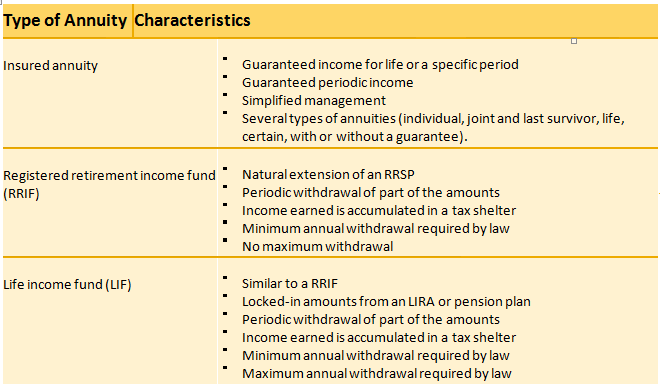
In exchange for a single lump sum investment, an insurer makes guaranteed regular income payments to an investor that contain both interest and a return of principal. Annuity payments can continue for the lifetime(s) of one or two people, or for a chosen period of time. As retirement income, annuities can be helpful in ensuring your essential expenses are covered.

Annuities can be ideal for investors who:

  • Want the highest guaranteed income amount possible from their investment
  • Wish to help cover essential expenses in retirement
  • Are concerned about outliving their savings
  • Wish to minimize tax on their investment income
  • Need to reduce the need for ongoing investment decisions
  • Want to subsidize early retirement income
  • Need income until pension and government benefits become available
  • Wish to fund a child’s ongoing educational costs

Registered Retirement Income Funds   (RRIFs)

A registered retirement income fund (RRIF) is the natural extension of a registered retirement savings plan (RRSP). It enables you to use the savings accumulated during your working life. With a RRIF, you may periodically withdraw a portion of the accumulated amounts, while continuing to accumulate savings generated income in a tax shelter. You must, by law, withdraw a minimum annual income, but no maximum withdrawal is applicable.

Life Income Funds (LIFs)

A life income fund (LIF), which is similar to a RRIF, is designed to allow you to withdraw amounts accumulated in a locked-in retirement account (LIRA) or a pension plan. LIF requires both a minimum and a maximum annual withdrawal.

Mutual funds products are offered through Investia Financial Services Inc.

(Commissions, trailing commissions, management fees and other expenses may be associated with mutual fund investments. Please read the Fund prospectus carefully before investing. Mutual fund investments are not guaranteed, their values change frequently, and their past performance may not be repeated. Mutual funds are sold exclusively by mutual fund representatives who are licensed by Provincial regulators and registered with Investia Financial Services Inc. (Investia). Investia does not provide or distribute any advice or product other than those that are directly related to the sale of mutual funds. Any representative who provides or offers other advice or services must hold the necessary licenses and deal with entities (other than Investia) that are duly registered with the competent authorities.)

Don't miss a listing, join our mailing list: